
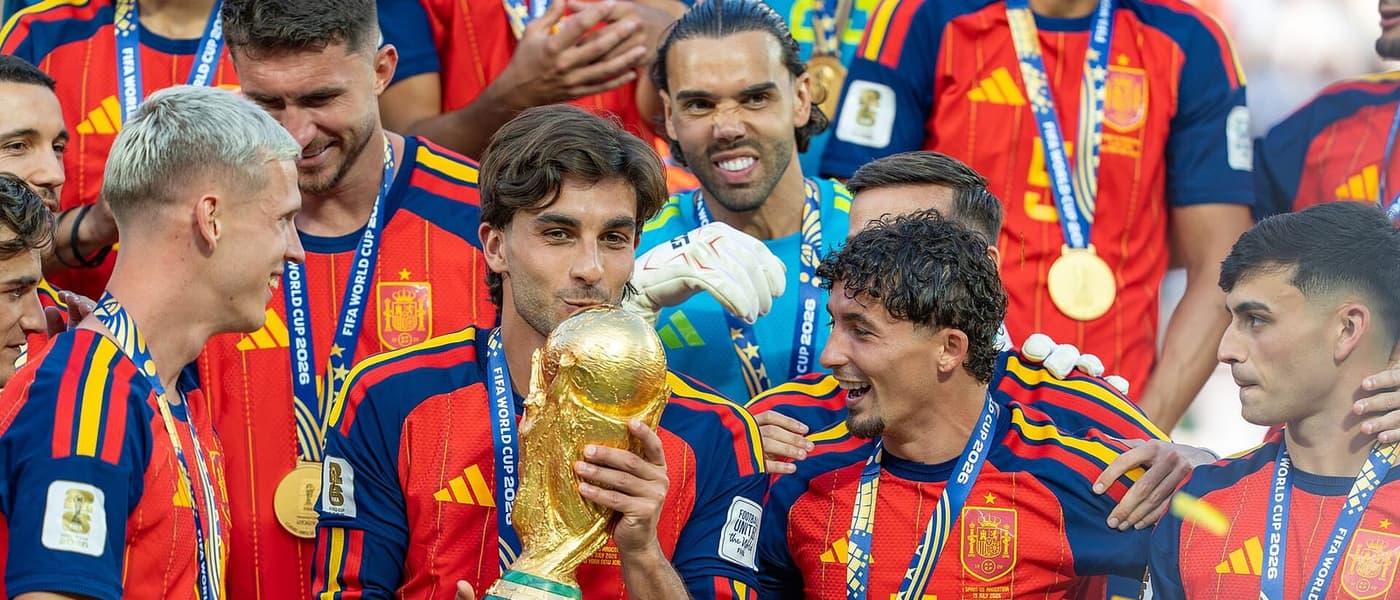
Ferran Torres: the doubted sub who won the World Cup
QuiniPrats editorial team
7 min read
Published on 6 August 2026
He came on in the 62nd minute with half of Spain against him. In the 106th he scored the goal that made Spain world champions. Weeks earlier he had admitted he nearly walked away from football.
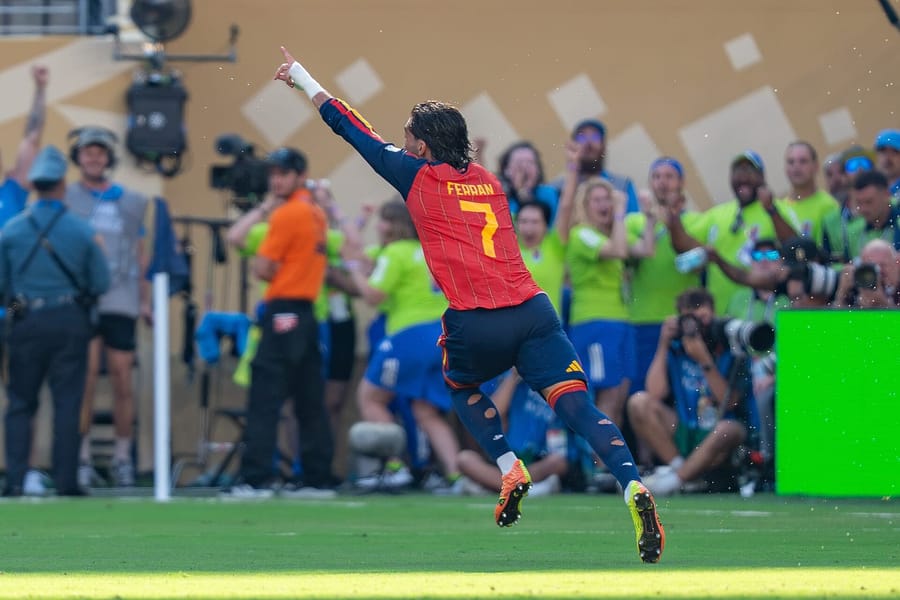
He came on in the 62nd minute knowing that a large part of Spain did not want him anywhere near the pitch. Forty-four minutes later, Ferran Torres scored the goal that made Spain world champions. The only goal of the 2026 World Cup final against Argentina, in the 106th minute of extra time, did not come from any of the stars everyone was watching. It came from the striker who had been picked apart since Spain's opening game of the tournament. And he scored it with his weaker foot.
The 106th minute: how Ferran Torres' World Cup final goal happened
The move took seconds and involved three players. Pedro Porro swung a cross in from the right, Nico Williams headed it back across goal, and Ferran Torres arrived to steer it in with the inside of his left boot — not his natural foot. It was his first goal of the 2026 World Cup. It was also the last act of a final Argentina had clung to grimly, and which slipped away from them entirely when Enzo Fernández picked up a second yellow card in the 93rd minute for a challenge on Pau Cubarsí. Spain played the whole of extra time against ten men.
- Final score: Spain 1-0 Argentina, after extra time.
- Venue: MetLife Stadium, East Rutherford, New Jersey, in front of 80,663 people.
- Date: Sunday 19 July 2026.
- Referee: Slavko Vinčić, the first Slovenian to take charge of a World Cup final.
- The statistic Argentina will not want to revisit: they did not register a single shot in the 90 minutes of normal time, a first in a World Cup final.
- Emiliano Martínez made 11 saves, more than any goalkeeper in a World Cup final.
Argentina went into the final with Lionel Messi and Julián Álvarez up front and Emiliano Martínez holding everything together behind them. Luis de la Fuente picked Unai Simón; Pedro Porro, Pau Cubarsí, Aymeric Laporte and Marc Cucurella; Rodri, Dani Olmo and Fabián Ruiz; Lamine Yamal, Mikel Oyarzabal and Álex Baena. None of the front three scored. The substitute did.
Torres was named man of the match. The first thing he did with a microphone in front of him was not talk about football.
I was heavily criticised during the World Cup, but I think it was written in destiny. At the end of the day, it was a goal scored by 47 million people.— — Ferran Torres, after the final
Before the goal: 'I lost the desire to train'
What makes this story more than a highlight reel is what sat behind it. Days before the final, Torres had told the documentary 'LaLiga, más allá del gol' that there had been a point when he seriously considered giving up football. Not because of an injury, and not because of an offer somewhere else. Because of the noise.
Nobody believed in me, everybody criticised me. I thought it wasn't getting to me, but in the end it was, because we're human beings.— — Ferran Torres, in 'LaLiga, más allá del gol'
'There came a point where I had no excitement about playing football, I lost the desire to train,' he said. He worked his way out of it with sports psychologist José Ángel Caperán, and what came out of that work is the line he now repeats like a mantra: when things are going well you are not the best and you must not get carried away, and when they are going badly you cannot lose all your confidence.
At 26, the Barcelona forward talks about therapy without dressing it up: 'I go to therapy once a week, sometimes twice, it's fundamental in my life.' It is a small sentence from an elite footballer in the middle of a major tournament, and that is exactly why it carries weight. For decades in Spanish football, that sort of thing was swept quietly under the carpet.
What minute did Ferran Torres score in the 2026 World Cup final? The 106th, in extra time. He had come on as a substitute in the 62nd minute and it was his first goal of the tournament. Spain beat Argentina 1-0 to win their second World Cup, and their first since 2010.
A second star, and a record nobody else holds
That 1-0 gave Spain a second star on the shirt and made them the first country to hold the men's and women's World Cups at the same time, having won the women's tournament in 2023. Argentina's head coach Lionel Scaloni did not reach for excuses afterwards: 'They were better, that's the truth.'
What this goal teaches you if you play a prediction league
There is a very practical lesson hiding inside the 106th minute. Finals are not settled only by the names on the front pages. More often than people expect, they are settled by the players who come off the bench, arriving with less pressure and more to prove. If you make predictions — in the Spanish quiniela or in a prediction league with friends — the 2026 World Cup handed out some fairly blunt reminders.
- Goals can arrive very late. In knockout football, do not treat a scoreline as settled before the 80th minute.
- A red card can rewrite a tight game: Enzo Fernández's dismissal on 90+3 left Argentina playing extra time with ten men.
- A striker in a barren run is still a striker. Do not write him off as a scorer just because of the drought.
- The clear favourite does not always win comfortably. A nervy 1-0 is a perfectly reasonable call.
When does Spanish club football return? LaLiga EA Sports 2026-27 begins on the weekend of 14–16 August 2026. Ferran Torres's Barcelona play their opening-round fixture against Athletic Club on Thursday 27 August.
What comes next for Ferran Torres
The 2026-27 season begins for him in a completely different place from the one he was in last summer. He is no longer the substitute nobody trusted; he is the man who scored the goal that won a World Cup. The more interesting question is the one he raised himself without meaning to: will he cope with the same noise when he goes two games without scoring? His answer, for now, is that he finally has the tools to handle it.
If the 106th minute proves anything, it is that games are worth watching to the very end. If you fancy following the new season with something at stake, you can set up a prediction league with friends on quiniPrats and compare your picks round by round, with no money involved. Sometimes the best part is exactly that: finding out the friend who knows least about football had called the substitute's goal all along.


Ready to compete?
Put what you've learned into practice and prove who knows football best.
Create free account